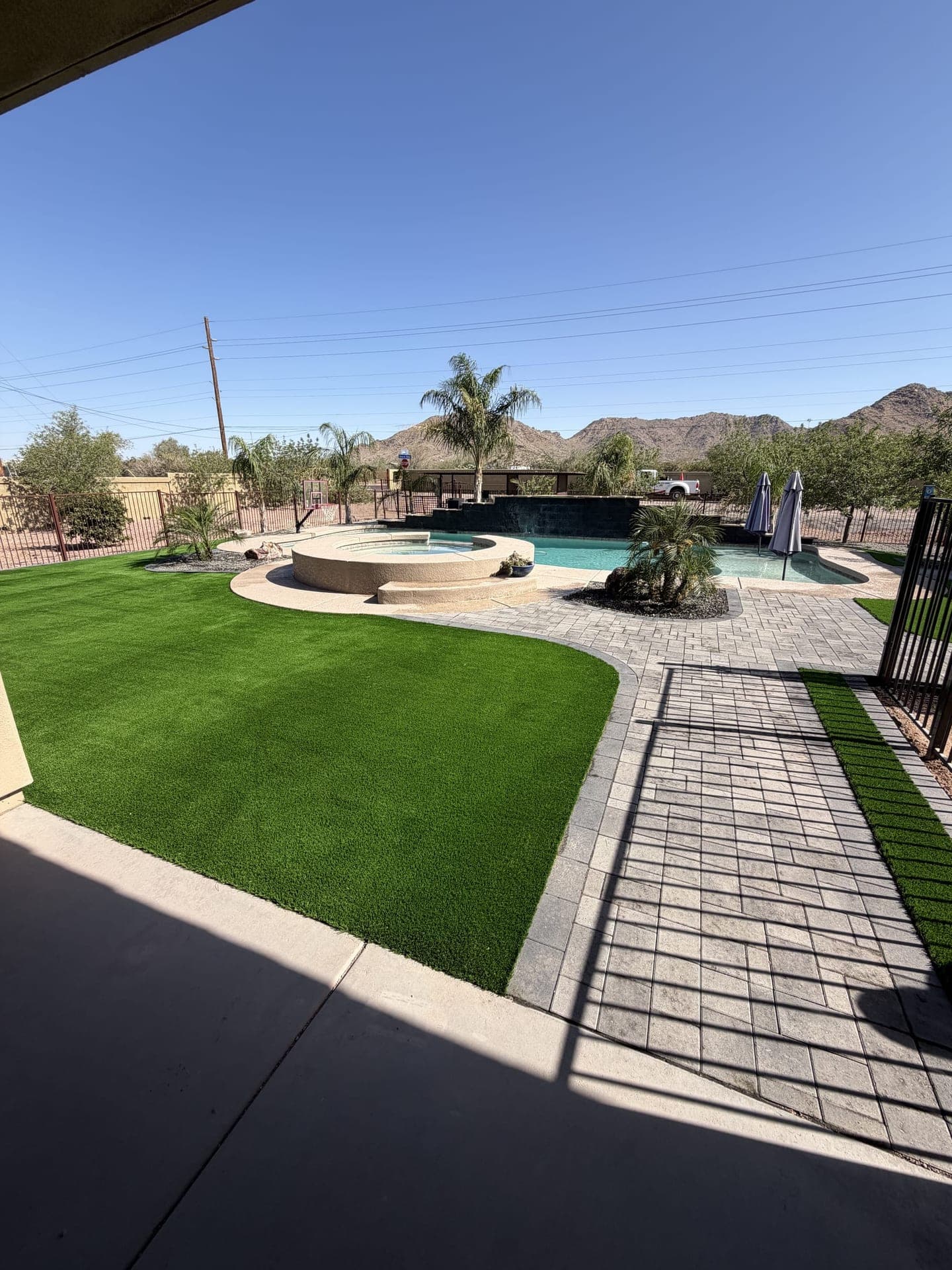
Arizona summers are not like other summers. When air temperatures hit 115°F in San Tan Valley and Queen Creek, dark-backed artificial turf can reach surface temperatures above 180°F. That's not a reason to skip turf — it's a reason to understand exactly how to take care of it.
Properly maintained artificial turf in Arizona lasts 15 to 20 years. Neglected turf fades, compacts, smells, and fails early. The difference is almost entirely maintenance — and most of it takes less than 30 minutes a month.
Here's what you actually need to do.
Why Arizona Heat Is Different for Artificial Turf
Natural grass cools itself through transpiration — the plant sweats moisture through its blades. Artificial turf has no such mechanism. On a 115°F day, synthetic fibers absorb and hold radiant heat, which is why turf surfaces in the East Valley consistently run 50–70°F hotter than the surrounding air temperature. Dark-colored or dark-backed turf runs even hotter.
The good news: modern residential turf is engineered for high-UV environments. UV-stabilized polyethylene fibers, permeable backing, and proper base drainage are all designed for climates like ours. Turf installed correctly in the East Valley handles Arizona summers without issue — as long as you give it basic attention.
6 Essential Turf Care Habits for Arizona Homeowners
1. Rinse Your Turf to Cool It Down
A thorough rinse with a garden hose is the most effective way to quickly drop turf surface temperature. In Arizona's dry heat, water evaporates fast — but even a 10-minute soak drops surface temperature by 30–50°F and makes the turf comfortable to use within minutes.
Rinse in the late afternoon or early evening before you plan to use the area. Morning rinsing isn't necessary for non-pet turf and does little in Arizona's heat — the surface reheats within the hour.
For pet areas and dog runs: rinse daily during summer. Urine breaks down fast in extreme heat and the ammonia smell compounds quickly. Daily rinsing is the single best thing you can do for pet turf odor control.
For standard residential turf: rinse once or twice a week during the hottest months — or whenever you're planning to be outside and want the surface comfortable.
2. Brush the Fibers Every Two Weeks
Foot traffic, furniture legs, and heavy use flatten turf fibers. In Arizona, it happens faster than in cooler climates because heat softens the fiber at the base, making compression more permanent over time.
Brush against the grain — opposite the direction fibers naturally lean — to lift them back to vertical. A stiff-bristle push broom works well. You'll see an immediate improvement.
Brush every two weeks in normal use areas, and after any event, party, or sustained heavy use. Monthly brushing isn't enough for Arizona conditions — by the time you brush, the fibers have been compressed long enough to affect appearance.
Never use a wire brush, metal rake, or any metal-tined tool. These fray and split fiber tips permanently. Use a synthetic-bristle broom or a purpose-built turf grooming rake.
3. Remove Debris Weekly
Dead leaves, mesquite seed pods, palo verde droppings, and wind-blown debris all break down faster in Arizona heat than in any other climate. Organic material that sits on turf in 110°F temperatures decomposes rapidly, works into the infill, and creates conditions for odor and bacteria.
A leaf blower is the fastest tool for the job — set to low, it clears debris without displacing infill. A stiff broom works equally well for smaller areas.
Make debris removal a weekly habit, particularly in spring when desert trees are actively dropping and in fall when monsoon winds deposit material across the yard.
Pay special attention to edges. Debris accumulates along the transitions between turf and pavers, concrete, or decomposed granite borders. Left there, it traps moisture under the turf edge and accelerates weed growth along the seam line.
4. Address Pet Waste and Spills Immediately
In Arizona heat, the window between a spill and a problem is hours, not days.
For pet urine: Rinse the area immediately and thoroughly — flush it, don't just mist it. Use enough water to dilute and move the urine through the backing and into the base below. For regular maintenance cleaning, an enzyme-based turf cleaner applied periodically breaks down ammonia at the molecular level.
Avoid bleach, ammonia-based cleaners, or any solvent-based product. These degrade both polyethylene fibers and the latex or polyurethane backing over time.
For solid pet waste: Remove it promptly, then rinse the spot. If odor persists, apply enzyme cleaner per the manufacturer's dilution instructions.
For food and beverages: Cold water rinse first to prevent anything from baking into the infill. For sticky or sugary residue, a small amount of mild dish soap in water, worked in gently with a soft brush, then rinsed thoroughly, removes residue without fiber damage.
5. Understand Your Infill and Top It Off When Needed
Infill is the granular material — typically silica sand, crumb rubber, or zeolite — installed between the turf fibers after laying. It serves three functions: it holds fibers upright, provides cushion underfoot, and helps the turf system drain properly.
Over time, infill compacts and migrates — especially in high-traffic areas and along slopes. In Arizona, foot traffic in summer heat accelerates compaction because the fibers are softer and the infill shifts more easily under load.
Topping off silica sand infill is a homeowner-level job. Purchase kiln-dried silica sand from a landscape supply store, broadcast it evenly across the turf, and brush it in against the grain. This is the most common infill type and the easiest to replenish.
Zeolite infill in pet areas is worth knowing about. Zeolite is a mineral that adsorbs ammonia and helps manage odor. It works well, but in Arizona's extreme heat it needs to be refreshed more frequently than in cooler climates — heat drives off the ammonia quickly and the zeolite's capacity depletes faster. Plan to refresh zeolite infill in dog runs every 12–18 months depending on use.
Crumb rubber or specialty infill replenishment should be done by your installer — the material, quantity, and application method matter more than with sand.
Signs your infill needs attention:
- Fibers flattening even after a thorough brushing
- Turf surface feels noticeably harder or crunchy underfoot
- Visible depressions or low spots in high-traffic areas
- Persistent odor in pet areas despite regular rinsing and cleaning
6. Inspect Seams and Edges Once a Year
Arizona's thermal cycling — cold winter nights followed by 115°F summer days — creates ongoing mechanical stress on turf seams and perimeter edges. Properly installed seams are glued with polyurethane adhesive on a seam tape base and rarely fail when done correctly. But an annual walk-around catches minor issues before they become bigger ones.
Look for:
- Edge lifting or pulling away from bender board, nailing strips, or concrete borders
- Seam lines becoming more visible (indicating adhesive breakdown or base movement)
- Any area where the surface has shifted, puckered, or developed a visible ridge
A properly installed turf job uses 6" galvanized nails on 4–6" centers along all perimeter edges and seams, with polyurethane adhesive on seam tape at all turf-to-turf joins. If an edge is lifting, it typically means a nail pulled or the nailing strip has moved — a straightforward repair when caught early.
What to Avoid
Open flame. Fire pits, grills, and tiki torches positioned too close to artificial turf will melt synthetic fibers — and melted fibers cannot be repaired, only replaced. Keep any open flame at least 5 feet from the turf edge. Floating embers from wood-burning fire pits are a serious hazard — use a spark screen and position your fire pit on a paver pad, not adjacent to turf.
Vehicles on turf. The weight of a vehicle crushes fibers and compresses the base in ways that cannot be corrected by brushing. Design your layout so vehicle access stays on concrete or pavers.
Chemical herbicides and pesticides. These aren't needed for turf itself — it doesn't grow. If weeds are pushing through from below, the problem is the weed barrier, not the turf surface. The right fix is addressing the barrier, not spraying chemicals that can discolor fibers and degrade backing. A small weed that breaks through can be pulled by hand or carefully spot-treated.
Pressure washing. Skip it entirely. A garden hose with a fan-spray nozzle does everything a pressure washer does for turf, without the risk of lifting seams, displacing infill, or splitting fiber tips. If your turf feels like it needs more than a garden hose, call your installer — that's a sign of a maintenance issue that needs diagnosis, not more water pressure.
When to Call a Professional
Most turf maintenance is homeowner-level work. These situations are not:
- Seam repair — improper DIY repair attempts almost always make seams more visible, not less. Seam adhesive requires proper technique and the right substrate prep.
- Persistent odor that doesn't respond to cleaning — this typically indicates either inadequate original drainage or a base that's retaining liquid. The fix starts at the base, not the surface.
- Turf that has shifted, buckled, or developed ridges — pulling back and re-stretching turf requires the right tools and re-nailing to the perimeter. This is not a DIY repair.
- Large-area infill replenishment — for anything beyond a small top-off, getting the right material, quantity, and distribution matters.
AMW Hardscape Solutions installs and services artificial turf across San Tan Valley, Queen Creek, Gilbert, Mesa, Chandler, and Apache Junction. If your turf needs attention beyond routine maintenance, contact us for an assessment.
Frequently Asked Questions
How hot does artificial turf get in Arizona? On a 115°F day, artificial turf in the East Valley can reach 170–185°F depending on color and backing. Dark green turf with a dark backing consistently runs hotter than lighter-colored or heat-reflective products. Evening rinsing with a garden hose drops the surface temperature dramatically within minutes — enough to make the turf comfortable to walk on barefoot. For households with young children or dogs who use the turf frequently during summer, a quick rinse before outdoor time is the right habit.
Does artificial turf need to be watered in Arizona? Not for the turf itself — it doesn't grow and doesn't need irrigation to survive. Rinsing serves three purposes: cooling the surface, cleaning debris and waste, and flushing material through the backing and base. The water savings compared to natural grass are substantial — bermuda grass in Arizona typically requires 35–55 gallons of water per square foot per year to stay green through summer. Artificial turf eliminates that entirely.
How long does artificial turf last in Arizona heat? A properly installed system using UV-stabilized polyethylene fibers should last 15–20 years in Arizona. UV degradation is the primary cause of premature failure — you'll see it first as fading and fiber brittleness. When selecting turf, confirm it uses UV-stabilized fibers and that the product is rated for high-UV climates. Cheap turf products often use polypropylene fibers, which degrade significantly faster under Arizona's UV index.
Can I install artificial turf myself? The materials are available at landscape supply stores, but installation is more involved than it looks. The base preparation — typically 3–4 inches of compacted decomposed granite over native soil, properly graded for drainage, with weed barrier beneath — is what determines how the turf performs and how long it lasts. Most DIY installs that fail do so within 2–3 years due to base prep errors: inadequate compaction, poor drainage grade, or skipped weed barrier. Professional installation ensures the base is done right the first time.
Is artificial turf safe for dogs in Arizona? Yes, with proper installation and maintenance. Specify a turf with perforated backing — not solid backing — so urine drains through rather than pooling on the surface. A properly graded DG base moves liquid away from the structure and prevents saturation. Zeolite infill in dog runs helps manage ammonia odor and should be refreshed every 12–18 months in Arizona heat. Rinse pet areas daily during summer. Enzyme-based cleaners handle residual odor effectively without damaging fibers or backing.
What should I look for when buying artificial turf for Arizona? Focus on three things: fiber material, backing, and face weight. Polyethylene fibers are the standard for residential turf — they're softer, more UV-resistant, and hold up better in heat than polypropylene. The backing should be permeable (perforated or flow-through) rather than solid. For residential use in Arizona, a face weight of 40–55 oz per square yard covers the range from putting-green applications to heavy-use backyard installs. Commercial or sports-grade turf runs heavier but isn't necessary for most residential projects. Infill selection — silica sand, zeolite, or a blend — should be matched to your specific use case at installation.
Ready to Install Artificial Turf in the East Valley?
AMW Hardscape Solutions installs artificial turf across San Tan Valley, Queen Creek, Gilbert, Mesa, Chandler, and Apache Junction. We spec the right product for your conditions, prepare the base correctly, and finish every job clean.
Get a free estimate or learn more about our artificial turf installation.