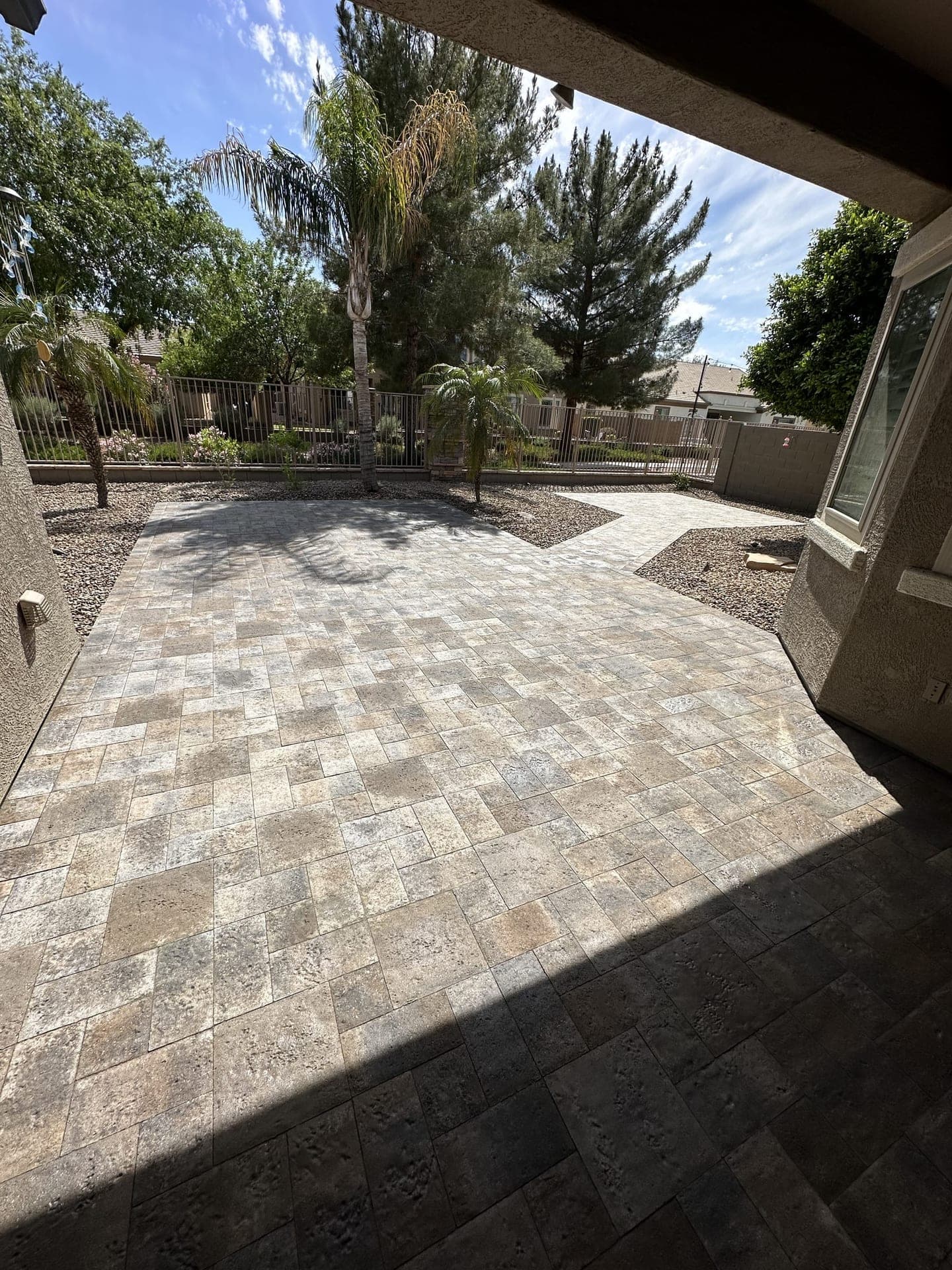
Queen Creek and San Tan Valley have grown fast, and most of that growth is production-built homes with a plain concrete slab out back. A paver patio is usually the first real upgrade homeowners make once the builder's landscaping allowance runs out — it's the difference between a slab you tolerate and a space you actually use most evenings. Here's what the process actually involves.
Why Pavers Work Well Here
Queen Creek and San Tan Valley sit on a lot of caliche — a hard, cemented soil layer common to this part of the East Valley that can start anywhere from a few inches to a few feet down. It's usually the first surprise on a bid: caliche has to be broken up and hauled out during excavation, and it swells once it's broken up, so there's more material to haul off than the hole itself would suggest. That's exactly why every quote starts with an on-site walk-through instead of a number over the phone — it's the only way to know what we're actually digging into before a shovel goes in the ground.
Caliche also barely drains, so the base has to be graded with somewhere for water to go — daylighted to a low point, not just piled on top and left. Skip that step and water perches on the caliche shelf, turns the bedding layer into a bathtub, and you get soft spots within a year or two.
It's also part of why pavers tend to outlast a poured slab on this ground. Concrete is one rigid piece — when the soil underneath shifts, even slightly, it cracks. Pavers are individual units set in sand, so the same movement just shows up as a joint easing a hair, not a crack running across the patio. We pour plenty of concrete ourselves and it's the right call for a lot of jobs — but on ground that moves, pavers have a structural edge, not just a style one.
The other reason pavers fit this area: most patios here are additions to an existing slab, not new construction. Pavers can be laid up to and matched into an existing patio or walkway with a clean tie-in, where a new concrete pour next to old concrete almost always shows a seam and a color mismatch.
What Goes Into the Install
Base first. A compacted aggregate base goes down before anything else — typically 4 to 6 inches for a patio, at least 6 for a driveway or RV pad, since the base spec follows the load, not just the surface. Grade and drainage direction get confirmed at this stage. This is the step that determines whether a patio holds for 30-plus years or starts shifting after the first monsoon season.
Pitch, not an afterthought. Minimum 1/8 inch of fall per foot, directed away from the house. In Queen Creek's newer neighborhoods, yards are often graded flat by the builder, which means the pitch has to be built into the patio design rather than following the existing slope.
Material choice matters more in direct sun. Travertine generally runs cooler underfoot than concrete pavers — though that's a color and density effect more than something magic about travertine as a stone; a light paver of either material beats a dark one. Travertine is natural stone, too, so budget for resealing it every year or two on a pool deck (every 3 to 5 years is fine in a shaded, low-traffic seating area) to keep pool chemicals and sunscreen from staining it. Concrete pavers are denser and skip that upkeep entirely. For driveways and high-traffic areas, concrete pavers are usually the better call; travertine earns its keep on the pool deck and seating areas where bare feet and looks matter most. (Adding parking? See our paver driveway installation page and our driveway extension guide.)
Pattern and cuts are planned before ordering, especially on an addition to an existing paver or concrete surface, so the finished patio reads as one continuous space instead of a visibly bolted-on extension.
Worth deciding now if a fire feature or outdoor kitchen is coming later. Both need their own footing and gas or utility runs planned into the base before the paver field goes down around them — adding one after the patio is finished means cutting into work that's already done. If that's on your radar even as a maybe, mention it at the estimate and we'll lay the base to accommodate it. See our custom outdoor spaces page for what that can include.
Joints get filled with polymeric sand, not plain sand. Regular sand washes out fast under a real monsoon downpour. Polymeric sand locks the joints, resists ants and weeds, and holds up far better through summer storms — but it has to go down dry and get a chance to cure before it takes on water, so that last step gets timed around the forecast too, not just the base work at the start of the job.
HOA Approval
Most Queen Creek and San Tan Valley communities are HOA-governed, and a good share require architectural approval before hardscape work starts — even for a patio that doesn't touch the property line. If you're on a horse property or an older unincorporated parcel, this step usually doesn't apply. If you are in an HOA, we put together a design diagram with full measurements, working off a street-view reference of your property, so you have what most HOA boards ask for without hiring a surveyor. Get it in front of the board before material shows up, not after — a mid-project stop-work order costs a lot more than the few days it takes to ask first.
Realistic Cost Ranges
Every quote comes from an on-site walk-through, not a square-footage formula — size, material, and how much caliche we hit during excavation are what actually set the price, and that last one varies yard to yard even on the same street. Get a free on-site estimate and we'll walk your yard and give you a real, written number — no obligation, no pressure.
Timeline
A standard-size patio (300–600 sq ft) usually runs 3–5 working days from demo/prep through final polymeric sand, weather permitting — and during monsoon season (mid-June through September), that caveat matters more than it sounds like. You can't properly compact a base that's still saturated from an overnight storm, so we'll push a start day rather than build on wet material and have it settle wrong months later. Larger backyard projects that integrate a patio with turf, rock, and other hardscape take longer and get scoped as one combined timeline, not sequential jobs.
Ready for a Paver Patio in Queen Creek?
AMW Hardscape Solutions is based in Queen Creek, and hardscape is the only thing we do. A patio built right is one of the few upgrades you actually get to live in every evening — and one that holds its value instead of needing to be redone in five years. Licensed (ROC #359843 · ROC #346552), insured, and built on a base that's designed to actually hold.
Get a free estimate or learn more about our paver installation.
Frequently Asked Questions
- How much does a paver patio cost in Queen Creek, AZ?
- Size, material, and site prep (especially caliche) drive the number, so we won't guess without seeing the yard. Get a free on-site estimate and you'll walk away with a real written price.
- Do I need HOA approval for a patio in Queen Creek?
- Most HOA communities in the area require it, even for additions that don't touch the property line. Horse properties and older unincorporated parcels are usually exempt. We provide a measured design diagram from a street-view reference of your property as part of the estimate, so you have what the board typically asks for. Get it submitted before material shows up, since that's a lot cheaper than a stop-work order.
- Does Queen Creek's soil affect paver installation?
- Yes, in two ways. Caliche slows the dig since it has to be broken up and hauled out, and it barely drains, so the base needs somewhere for water to go instead of pooling underneath. Both get handled during base prep, not patched in afterward.
- What's the best paver material for Arizona heat?
- Lighter-colored pavers of any material stay cooler than dark ones. Travertine tends to run cooler as a category and looks right on a pool deck, but it's natural stone and needs resealing every year or two in that kind of exposure. Concrete pavers skip that upkeep and are the better choice for driveways.
- How long does a paver patio take to install?
- 3–5 working days for a standard size, base prep through polymeric sand. Add time during monsoon season if a storm delays compaction or the final sand needs a dry window to cure.
- Do you install paver driveways too, or just patios?
- Both. Since the base work overlaps, doing a patio and a driveway extension in the same visit is often more efficient than scheduling them separately.
- Are you actually local to Queen Creek, or is that just a service area listing?
- We're based here. Queen Creek and San Tan Valley are home turf, not territory we drive into. We still cover Gilbert, Mesa, Chandler, and Apache Junction, but Queen Creek jobs are the closest ones.
- Can I add a fire pit or outdoor kitchen to the patio later?
- Sometimes, but it shows. Retrofitting a footing or a gas line into a finished patio usually means cutting pavers and disturbing a base that was already compacted and set. If there's any chance you'll want one down the road, tell us at the estimate and we'll build the base to take it from day one.