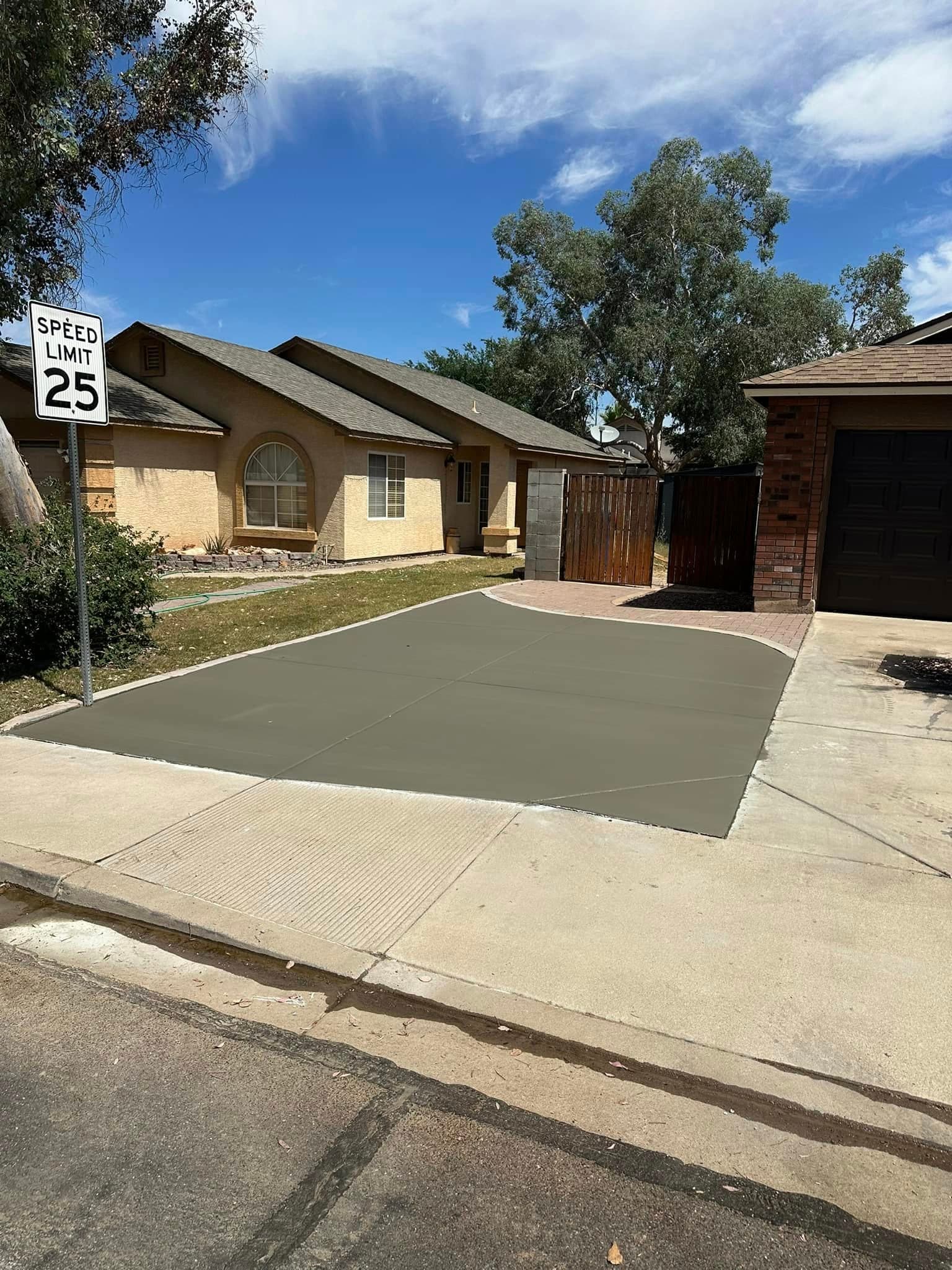
Short answer: both work. Concrete is the simpler choice when you want an extension to blend in with an existing concrete driveway. Pavers make sense when you want it to look like a planned upgrade, and they're easier to repair. Either one only lasts on East Valley ground if three things are right: the base, the tie-in to the existing driveway, and the drainage.
How Wide Should a Driveway Extension Be?
Size it for what will park there.
- Another car: plan on 9 to 10 feet of width. A 3- or 4-foot widening won't hold a car, but it gives passengers a place to step out besides rock.
- An RV or trailer: most are up to about 8½ feet wide. A 12-foot pad leaves room to walk around it and open doors, and slide-outs need more. A side-yard RV pad needs a gate at least 10 feet wide (12 is easier) and enough room for the rig to swing in straight from the street.
- A turnaround: a pad off one side of the driveway lets you back in and pull out forward instead of backing into traffic.
What Gets Checked Before Digging?
Utilities. Arizona law requires underground utilities to be marked through Arizona 811 at least two full working days before digging. Water meter boxes, irrigation valves, sewer cleanouts, and drip lines often sit right where a widening needs to go. Irrigation has to be rerouted before the base goes in, and any box that ends up under the new surface needs a traffic-rated lid set flush. The water meter belongs to your water provider, so moving it goes through them.
Ground. Soil in Queen Creek and San Tan Valley often includes caliche, a cemented layer that's hard to dig and barely drains. Soft or loose spots in the native soil need to be dug out and replaced, not covered over. Under every concrete driveway addition, we put down 4 to 6 inches of compacted aggregate base.
Drainage. Driveways here are pitched to drain toward the street, and an extension has to keep that fall so water never runs back toward the garage or sits against the house. We confirm the existing drainage direction before designing anything. On larger lots, especially horse properties, the front yard may include a retention basin or drainage swale required by the town or the subdivision plan. Paving into it sends monsoon runoff somewhere it wasn't designed to go.
How Is a Concrete Driveway Extension Built?
Tie-in. We saw-cut the edge of the existing driveway and dowel the new slab into it with epoxy-set rebar at 18-inch centers, so the two slabs move together instead of separating at the seam. Where the new slab meets the house or garage, an isolation joint keeps it from bonding to the foundation.
Control joints. Concrete cracks; control joints decide where. We cut them at a maximum of 10-foot spacing, to one-quarter of the slab depth. New joints should line up with the existing driveway's joints, because a joint that dead-ends at the seam tends to send a crack into the new slab. Long, narrow strips crack more easily than square panels, so a 3- or 4-foot widening needs joints closer together.
Thickness. Most car driveways here are 4 inches thick. An RV pad should be thicker and reinforced with rebar. Six inches is a common starting point, with the final spec based on the weight of the rig.
Heat. Arizona heat and dry air pull water out of fresh concrete fast, which causes surface cracking and a weaker top layer. That's why summer pours start at first light, the base is dampened before the concrete goes down, and the slab is cured with a curing compound or kept moist.
Color. New concrete won't match a slab that has been in the sun for years. The difference softens over time but doesn't disappear. Matching the existing broom finish and its direction helps. If an exact match matters, a paver band at the seam turns the transition into a design line.
Curing. Foot traffic is fine after a day or two. Wait about 7 days before parking a car on it, and about 28 days for an RV, a loaded trailer, or a heavy truck. That's when concrete reaches its design strength.
How Is a Paver Driveway Extension Built?
Guidelines from the Interlocking Concrete Pavement Institute, now part of the Concrete Masonry & Hardscapes Association, cover the core spec for a paver driveway:
- Paver thickness: 60 mm (2⅜ in.) is the minimum for a residential driveway. 80 mm pavers are the stronger choice for an RV pad or heavy trucks.
- Pattern: herringbone. The pavers lock against each other in both directions, which holds up best under turning tires.
- Base: at least 6 inches of compacted aggregate on well-drained soil, and more on soft ground or under an RV.
- Edges: the open edges need a concrete restraint so tire loads don't push the outer pavers out of line. Where pavers meet the existing concrete driveway, the slab edge holds that side.
Joint sand. Polymeric sand locks the joints and resists weeds and ants. It has to go down dry and set before cars drive on it, usually a day or two depending on the product and the weather.
Repairs. If a section settles or picks up an oil stain, those pavers can be lifted and reset or replaced. With concrete, the fix is cutting out and repouring a section.
Looks. Pavers next to concrete don't try to match it, so there's no color difference to manage. Some homeowners also run a paver border along the existing driveway so the whole thing reads as one design. For materials, patterns, and base work, see our paver driveway installation page.
Concrete or Pavers: Which Should You Choose?
- Concrete if you want the extension to blend in with an existing concrete driveway.
- Pavers if you want it to look like a planned upgrade, want simpler repairs, or may add a paver border to the existing driveway later.
- For an RV or heavy trailer, either works when it's built for the load: a thicker reinforced slab, or 80 mm pavers on a deeper base.
Do You Need HOA Approval or a Permit?
HOA. Most HOA communities in Queen Creek and San Tan Valley require architectural approval for front-yard hardscape. Many only allow RVs and trailers behind a gate or view wall, and some don't allow them on the lot at all. Some HOAs also limit how much of the front yard can be paved. Get approval in writing before work starts. For the HOA submission, we put together a design diagram with full measurements, working from a street-view reference of your property.
Right-of-way. On a public street, the curb, the driveway apron, and the sidewalk are public right-of-way. Work there needs a right-of-way permit from whoever owns the street:
- Queen Creek: the Town of Queen Creek
- San Tan Valley, inside town limits: the Town of San Tan Valley, which took over right-of-way permits from Pinal County on July 1, 2026
- Unincorporated areas outside town limits: Pinal County
- Private streets in a gated community: your HOA
Many local residential streets here have a rolled curb that cars can drive over, so some widenings stay entirely on your side of the sidewalk. A vertical curb usually means widening the curb cut, which is right-of-way work.
Get a Written Quote
AMW Hardscape Solutions is based in Queen Creek. We'll walk the property, check the drainage and what's in the path, and give you a written quote for concrete, pavers, or both. Licensed (ROC #359843 · ROC #346552) and insured.
Get a free estimate or see our driveway additions. Planning a patio too? See our Queen Creek paver patio guide.
Frequently Asked Questions
- How much does a driveway extension cost in Queen Creek, AZ?
- It depends on the square footage, the slab thickness or paver spec, how much rock and landscaping has to come out, irrigation reroutes, and whether the work touches the curb or sidewalk. AMW gives free on-site estimates with a written quote and can price concrete and pavers side by side.
- Does AMW build driveway extensions outside Queen Creek?
- Yes. AMW Hardscape Solutions is based in Queen Creek and builds driveway extensions, parking pads, and RV pads across the East Valley, including San Tan Valley, Gilbert, Mesa, Chandler, Apache Junction, and Maricopa.